


LMS Learning Management System
- Home
- portfolio
- Development
- Graphic Designing
- LMS Learning Management System
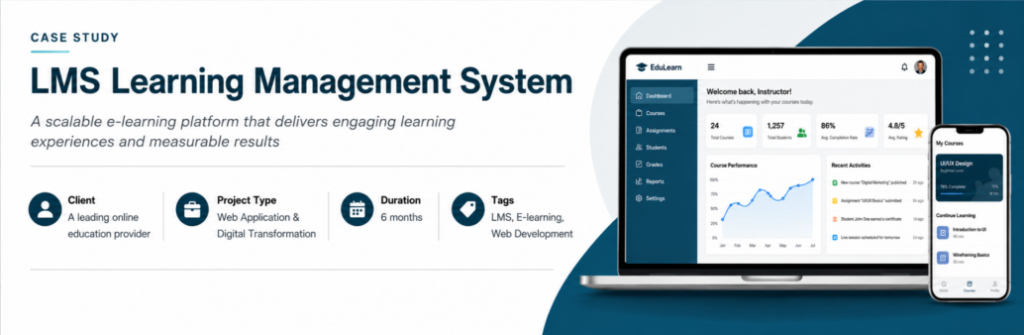
Centralizing learning, assessment, and training operations in one scalable digital platform
| Client | A growing multi-campus education and professional training organization |
| Project Type | Learning Management System, Web Application & Digital Transformation |
| Duration | 6 months |
| Tags | LMS, E-Learning, Web Development, Cloud Solutions |
This case study presents an LMS implementation developed by GhamerSoft. Client details have been generalized and performance figures are representative.
About the Client
The client is an education and professional training organization managing instructor-led and online programs across multiple campuses and learner groups. Its teams coordinate course delivery, enrollment, assessments, attendance, learning resources, instructor activity, and learner communication across a growing digital ecosystem.
The Key Challenge
The client needed a unified learning platform that could replace fragmented training workflows, give learners a consistent digital experience, and provide administrators and instructors with reliable visibility into course progress and performance.
- Course materials, assignments, quizzes, announcements, and learner records were managed across disconnected tools.
- Learners needed one place to access lessons, submit work, review grades, and track progress.
- Instructors needed faster ways to publish content, manage assessments, monitor participation, and communicate with cohorts.
- Administrators needed clearer visibility into enrollment, completion, attendance, assessment performance, and inactive learners.
- Multiple programs and user roles had to operate securely within one scalable learning system.
Our Solution
GhamerSoft designed and developed a modern Learning Management System that brought course management, learner engagement, assessments, communication, reporting, and administration into one workspace. Role-specific experiences allowed learners, instructors, coordinators, and administrators to complete core activities through a consistent and secure interface.
Key Capabilities
- Learner Dashboard: Personalized access to enrolled courses, upcoming activities, progress, deadlines, and announcements.
- Course & Content Management: Structured lessons, video resources, documents, learning paths, prerequisites, and reusable course content.
- Assessments & Quizzes: Configurable quizzes, assignments, grading workflows, attempts, scoring rules, and feedback.
- Progress Tracking: Course completion, lesson progress, assessment results, attendance indicators, and learner activity history.
- Instructor Workspace: Tools for publishing lessons, reviewing submissions, communicating with learners, and monitoring cohort performance.
- Certificates: Automated completion certificates based on configurable course or program requirements.
- Role-Based Access: Separate permissions and workflows for learners, instructors, coordinators, and administrators.
Implementation Approach
The project was delivered in five focused phases:
- Discovery: Mapped learning workflows, user roles, course structures, assessment requirements, and reporting needs.
- Architecture: Established the application architecture, database model, authentication, and cloud environment.
- Core LMS: Built learner, instructor, course, enrollment, content, and administration workflows.
- Assessment & Engagement: Introduced quizzes, assignments, grading, notifications, progress tracking, and certificates.
- Rollout: Migrated initial course content, onboarded staff, trained administrators, and moved the LMS into production.
Seamless Integration
The LMS organized the learner journey—from enrollment and course discovery through lesson completion, assessment, feedback, and certification—within a single interface, reducing the need to move between separate learning and communication tools.
Faster Resolution
Reusable course structures, centralized submissions, grading options, and cohort-level progress views helped instructors spend less time on administration and more time supporting learners.
Scalable Cloud Architecture
A cloud-based architecture provides flexibility for growing learner volumes, additional programs, and future integrations while maintaining a centralized foundation for identity, content, reporting, and administration.
| 32% | Reduction in average administrative time spent managing course activities |
| 27% | Increase in on-time assignment submissions |
| 41% |
Of learner support requests resolved through self-service LMS guidance and resources |
Technology Stack
- Frontend: React
- Backend: Node.js
- Database: PostgreSQL
- Learning Content: Structured course modules, video, documents, quizzes, and assignments
- Cloud: AWS
- Authentication: Role-based access control and secure authentication
- Analytics: Custom operational dashboards and reporting
Client Perspective
“The LMS gave our learners one clear place to access their courses and track progress, while our instructors gained much better visibility into participation and assessments. The biggest improvement was having learning operations, content, and reporting connected in one system.”
— Representative client perspective, Learning & Development leadership role
Projecct Summary
| Client | A growing multi-campus education and professional training organization |
| Start Date | January 2026 |
| Duration | 6 months |
| Services | LMS Development, Web Application Development, Cloud Solutions |
| Industry | Education & Professional Training |
| Outcome |
Centralized learning delivery, improved operational efficiency, and stronger learner visibility |